
213-302-8000

Poor Market Performance Over Third Quarter
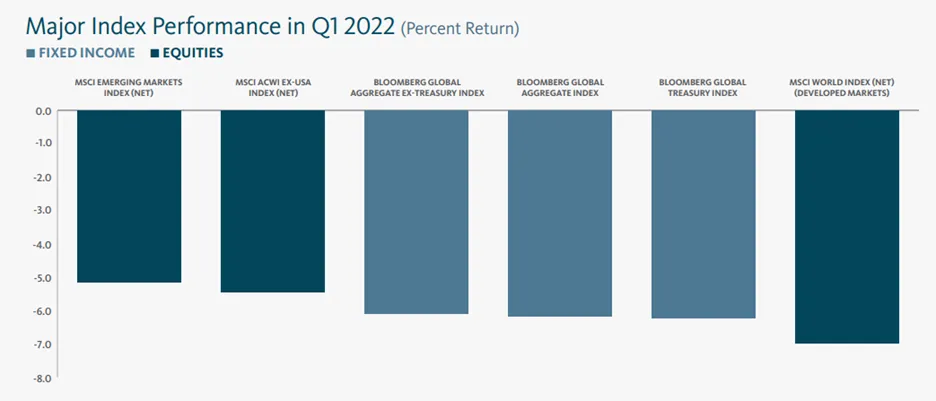
Investors faced inhospitable conditions on multiple fronts during the first three months of 2022. Global equities delivered their poorest quarterly performance since early 2020—bottoming in mid-March before mounting a sharp partial recovery. Global bonds fared worse, tumbling by the most since late 2016. U.K. stocks earned a positive return during the quarter, outpacing other major markets. Hong Kong was slightly negative, while the U.S., Japan and Europe had steeper losses. Mainland Chinese equities bounced higher after plummeting from mid-February to mid-March, but still finished the quarter with double-digit losses. The selloff in Chinese equities was most severe in technology companies, forcing Vice Premier Liu He—China’s top economic advisor—to pledge that the government would take a “standardised, transparent and predictable” approach to the regulation of technology; this comes after more than a year of interventions. Beijing also made broader overtures to soothe investors, including prioritising the stability of capital markets, supporting overseas stock listings, and pledging to manage the risks associated with solvency issues plaguing property developers.
Russia Experiences Heavy Sanctions After Invasion
On the other side of the spectrum was Russia—the greatest loser by a wide margin—as its aggression against Ukraine opened the door to an expansive set of coordinated economic restrictions, imposed rapidly and with a high degree of uniformity across Western powers. The country’s banishment from global financial systems translated into massive declines in the value of Russian securities.
In the immediate aftermath of the invasion, the European Commission, France, Germany, Italy, the U.K., Canada, and the U.S. committed to taking several actions including removing Russian banks from the SWIFT (Society for Worldwide Interbank Financial Telecommunication) messaging system for financial payments; blocking the Russian Central Bank from deploying its international reserves; limiting the sale of citizenship to wealthy Russians; and launching a transatlantic task force to freeze the assets of sanctioned entities.
The imposition of these coordinated sanctions has effectively blocked Russian entities from trade in major foreign currencies. The Russian Central Bank was forced to increase its benchmark rate by a considerable 10.5%, to 20.0%; offer unlimited liquidity support to banks as they faced runs; raise capital controls on exporters and residents; and shutter its financial markets.
Attacks on Ukraine Impact Oil Prices
Meanwhile, with commodities markets having been the epicenter of the financial fallout from Russia’s attacks on Ukraine, commodities had their strongest quarter in at least 30 years. The price of natural gas spiked by more than 50%, while WestTexas Intermediate and Brent crude-oil prices both climbed by over 30%. The price of wheat also increased by more than 30%. Commodity-producing nations, therefore, were the first quarter’s big winners, led at a distance by Latin American equities’ double-digit gains.
By mid-March, the EU had instituted a broad ban on investments in Russia as well as exports to and imports from the country (although imports of Russian metals and energy are still permitted). Russian state-controlled companies across an array of industries are blocked from trading with the EU, while prominent Russian individuals (including business executives, media personalities and oligarchs) faced asset freezes and travel bans. The U.S. went a step further in banning all new purchases of Russian energy imports, allowing a 45-day wind-down period for existing agreements. Also in mid-March, Russia legalized the nationalization of more than 500 airplanes leased to Russian airlines by Western companies. This came after an early-March move to restrict the export of more than 200 products and raw materials until the end of 2022; although its chief commodity exports were not included.
Heavy Bond Losses Over Quarter
Bonds delivered an array of negative performances as interest rates climbed (yields and prices have an inverse relationship). Inflation-indexed securities had relatively mild declines, while emerging-market debt and investment grade corporates tumbled dramatically. The longest-term government bonds in advanced economies posted double-digit losses.
Russia Demands Ruble Payments for Oil
More recently, Russia began to demand ruble payments for gas exports to Europe instead of accepting U.S. dollars or euros, sending European gas prices soaring. The Group of 7 (G7) explicitly rejected the Russian demand in late March. At the end of the quarter, Russia’s Transneft—the largest oil pipeline network in the world—alerted local oil-producing companies that it would cap acceptance of oil that had not already been sold as storage capacity was full. The European Commission announced in mid-March that the electricity grids of Ukraine and Moldova were now synchronized with that of Continental Europe rather than with Russia; this was done in an effort to help the two countries reduce their dependence on Russia and improve their electricity system reliability.
Strong Employment Additions over March
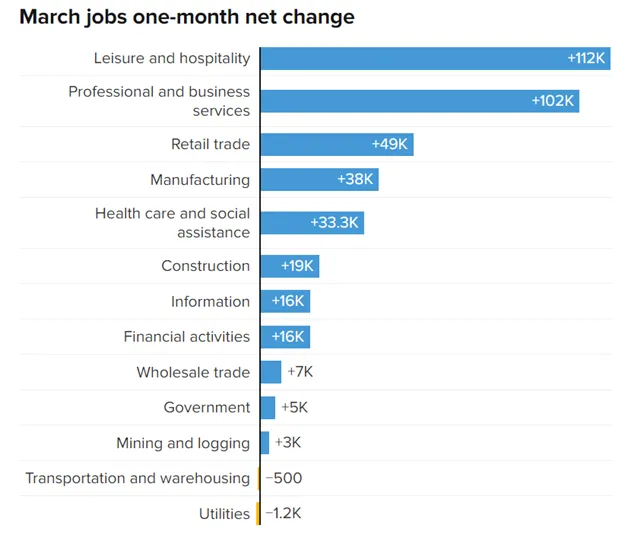
As Covid restrictions eased, rebounds in the leisure and hospitality and business sectors helped to drive a strong March jobs report.
The U.S. economy added more than 400,000 jobs in the final month of the first quarter, the Labor Department said Friday.
Leisure and hospitality, which includes hotels, restaurants and amusement parks, added a net 112,000 jobs in the third month of 2022. Within the industry, restaurants and bars added 61,000 jobs, hotels and other lodging businesses tacked on 25,000 and amusement, gambling and other recreation climbed 16,400.
Correlation Between Equities and Bitcoin Grows
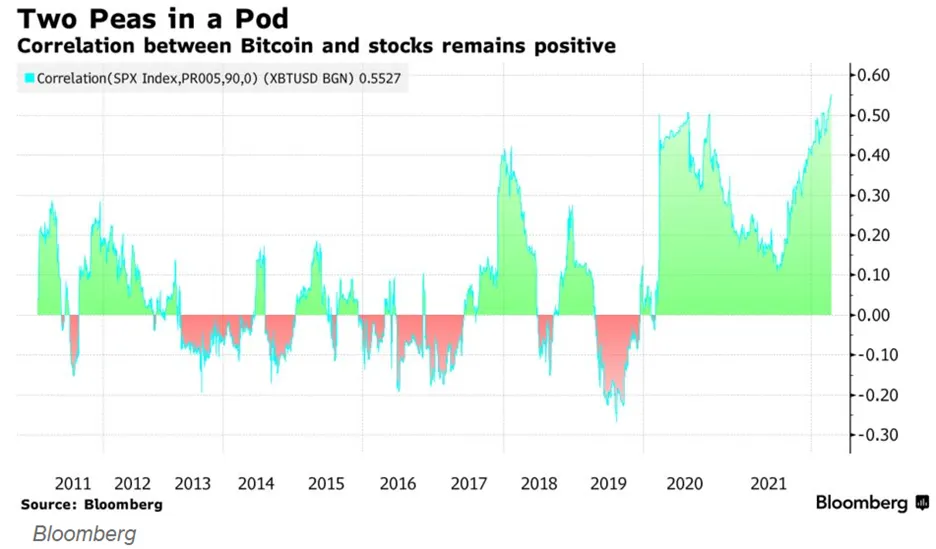
The correlation coefficient between the Bitcoin and U.S. equities have climbed in the past 90 days as investors grow more risk adverse with the Federal Reserve pulling back on the pandemic era stimulus that is credited for helping to fuel the rise of crypto. Alternative coins such as Ether, XRP and Litecoin also fell.
Minutes from the Federal Open Markets Committee’s March meeting, released Wednesday, showed plans to start reducing the Fed’s balance sheet by more than $1 trillion a year while raising rates “expeditiously” to counter the hottest inflation in four decades.
Bitcoin briefly surpassed $48,000 in late March to erase losses since year-end, spurring optimism that it would break out of the tight trading range in which it had been mired. Ether had been outperforming Bitcoin during the rebound due to its upcoming technical upgrade scheduled later this year.
If you are interested in adapting your portfolio to current market conditions or are interested in changing or adding new investment strategies, please contact us at [email protected]
Or Click Here to Schedule a free consultation
Connect With Us
Wealth Excel is a highly specialized consulting and investment advisory company providing wealth-growth solutions for profitable small business owners through comprehensive tax-saving strategies, precision retirement plans, and custom-built investment portfolios.
Headquartered in Los Angeles, CA the Wealth Excel team has 50 years of combined experience serving the needs of high-income and high net-worth clientele nationwide.
2021 Wealth Excel LLC. All rights reserved.
HEADQUARTERS
1055 W. 7th Street, Suite 3260
Los Angeles, CA 90017